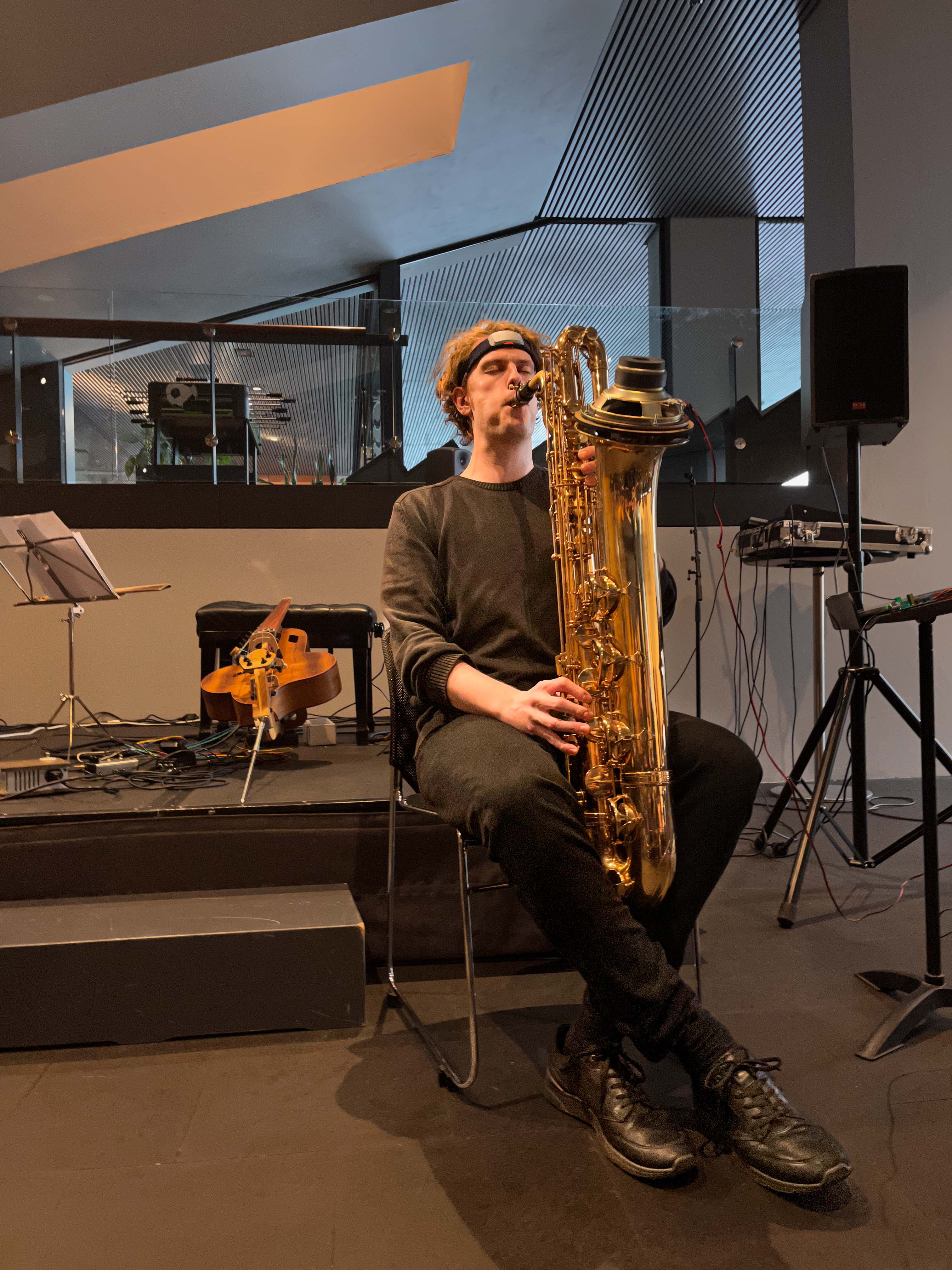
Saxophonist, composer, audio-visual artist, developer. My practice combines improvisation with interactive systems and audio-visual installations, translating signals, gestures, and environments into dynamic sonic and visual processes.
Download Max 4 Live Device: NMF Decomposer
Olafur Eliasson’s artworks are often based on meticulous scientific and mathematical work with the material, but are only completed through audience perception and engagement. This principle is also central to his work for Colour Experiment No. 78. Although the colors remain constant, our perception of them changes under yellow light. This artwork inspired me to create a four channel audio installation based on similar principles, which was exhibited together with Olafur Eliasson's work at the Van Gogh Museum during a cooperation with the Conservatorium van Amsterdam. The visible light spectrum from 380 to 750 nanometers is mapped to 1024 sinusoidal oscillators ranging from 380 to 750 Hz. The outputs of the oscillators are amplitude-modulated by another 1024 oscillators mapped to the color yellow, which are synced to the intensity of the yellow light using a sound sensor. Phase cancellations between the oscillators generate rhythmic patterns that slowly change in speed, drifting in and out of alignment.
Light installation: Olafur Eliasson,
Audio installation: Michael Maria Ott
The project explores the interplay between machines, data, humans, and musical expression. The performers improvise over an audio-visual installation that is generated in real time based on their heartbeats. Each performer's heartbeat is measured by a pulse-sensor and represented by a piano voice (triggered on each heartbeat) and a strings voice (triggered every 4th heartbeat). The note choice is determined by the heart rate and the interaction of the two heartbeats. Every time the heartbeats trigger at the same time, the note choice relative to the heart rate changes, and a new key is calculated based on the average heart rate of both performers.
This piece was published at the media center of the University of Music and Performing Arts Mannheim.
Double bass: Henriette Thorun
Saxophone, Composition, Programming: Michael Maria Ott
Recorded at RE:VIVE Studio in Hilversum.
A video of an Icelandic landscape functions as a graphic score for both the performer and the electronic sound design. The video's colors are analyzed in real time and mapped to various parameters of the saxophone's sound processing. Alongside the video itself, the landscape-specific soundscapes guide the instrumentalist's performance.
This piece was published at the media center of the University of Music and Performing Arts Mannheim.
Saxophone, Composition, Programming: Michael Maria Ott
The piece constructs a soundscape defined by feedback loops and acoustic resonance, where the saxophone and drums interact directly with the circuitry itself. Tape recordings, digital synthesizers on obsolete micro-chips and saxophone are mixed through electronic effects fed into a feedback loop by being played back and re-recorded through the drum skin. The performance manipulates time and texture in real-time, creating a dialog between the organic resonance of the instruments and the decaying signal of "dead" technology.
Drums, Tape, Effects: Ruggero Di Luisi,
Saxophone, Synthesizer, Effects: Michael Maria Ott
A solo bass saxophone performance that moves between composition and improvisation. Sound is spatially dispersed throughout the room via a custom audio decomposition system, transforming the instrument into a multi-dimensional presence. The mechanical key clicks form a percussive layer, while a persistent ostinato anchors the piece with raw, unyielding harmonics. Interwoven with this, the performer’s humming is captured, processed, and reconstituted into shifting spectral melodies that blur the boundary between acoustic and electronic sound. The duration is indeterminate, governed by the performer’s physical endurance. As fatigue sets in, the embouchure destabilizes and the sound begins to fracture, gradually collapsing like overstrained machinery, where control gives way to entropy.
A real-time interactive system designed for free improvisation. By attaching light and motion sensors directly to the instruments’ the performers control audio effects through gesture and presence. The accompanying visuals are controlled by a hybrid input system driven by both the live audio feed and the performers’ motion data.
Drums: Ruggero Di Luisi
Bass: Antonio Izzo
Saxophone, Sensors, Visuals: Michael Maria Ott
This project, developed as an associate at the Intelligent Instruments Lab and performed at the Nordic Music Days 2022 in Iceland, explores the potential of consumer-grade EEG headsets to control aspects of a live performance by combining real-time brainwave sonification with free improvisation. By projecting the sonified EEG signals into the bell of the saxophone using a custom speaker-mount, the body of the saxophone not only acts as a filter for the sound, but also allows the sound of the EEG to interact with the saxophone sound, changing its harmonic structure.
The three-voice composition explores the sound worlds of two rave models (Realtime Audio Variational autoEncoder), one of which is trained on humpback whale songs and the other on water sounds. The sound of the soprano saxophone is resynthesized by the humpback whale model in real time, whereby the timbre of the humpback whale songs is transferred to the saxophone sound. In a second voice, the encoding process of the timbre transfer is bypassed and the decoding parameters are controlled directly by an algorithm. The result are strange, machine-like variations of the whale songs, with which the saxophonist enters into a dialog during the course of the composition. The conversation between the two voices is fed into the water-trained rave model at a very slow pace, creating the third voice, a slowly evolving soundscape that is directly influenced by the other voices. The rave models where trained by the Intelligent Instruments Lab and are available here.
The solo bass saxophone improvisation drives a reaction-diffusion algorithm. The instrument’s timbre, pitch, and amplitude act as live control parameters, causing the visual simulation to bloom, recede, and shift in real-time, creating a symbiotic relationship between the sound and the digital ecosystem.
Michael Maria Ott (*1993) is a German saxophonist, improviser, composer, and developer for live electronics.
He completed his Bachelor’s degree in Jazz Saxophone at the Mannheim University of Music and Performing Arts and his Master’s degree in Live Electronics at the Conservatorium van Amsterdam.
His work combines improvisation with complex digital systems, both in live performances and interactive installations.
Focusing on the intersection of humans, machines, and data, he develops interactive systems that translate biological signals, environmental data, and gestures into sound and visual forms in real time.
Using self-programmed algorithms and custom-built sensors, he creates non-linear interactions that expand traditional performance formats.
His ensemble projects range from Dead Electronics, where saxophone and drums merge with obsolete microchips through feedback loops, to Risc, a free jazz trio in which light and motion sensors mounted on the instruments directly control audio effects and visual projections. His solo performances on bass saxophone further extend the instrument’s sonic possibilities by amplifying key noises and vocal elements through contact and throat microphones, creating an expanded and immersive sound space.
Michael Maria Ott
+4917655554042
mail@michaelmariaott.com
Uhlandstr. 38
68167 Mannheim